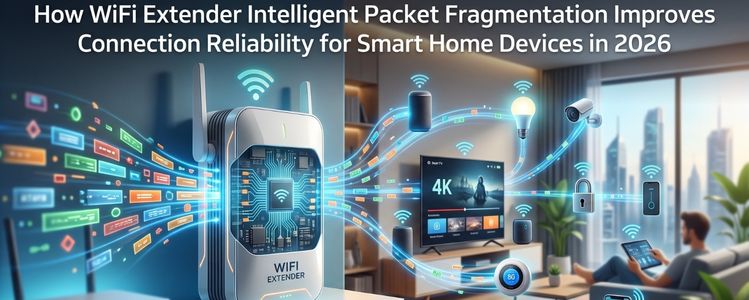
Smart homes are becoming more connected than ever in 2026. A typical household may have smart cameras, doorbells, speakers, thermostats, televisions, lights, locks, appliances, smartphones, and other connected devices working at the same time. While these devices make everyday life more convenient, they also place greater demands on the home WiFi network.
One issue that can affect wireless reliability is the way data packets are transmitted across the network. When packets are too large for the available transmission conditions, they may need to be divided into smaller pieces. Intelligent packet fragmentation can help compatible networking equipment manage this process more efficiently, particularly when wireless conditions change.
For households using WiFi extenders, better packet handling can contribute to a more reliable connection between smart devices and the main network. Devices identified through network names such as Netgear_ext may rely on an extender connection to communicate with the internet and other devices in the home.
Before data can travel across a WiFi network, information is divided into smaller units called packets. These packets travel between devices and are then reassembled at their destination.
In some situations, a packet may be too large for a particular network path or transmission condition. Fragmentation allows the data to be divided into smaller pieces so it can be transmitted successfully.
The challenge is that fragmentation can also create additional network overhead. If it is handled inefficiently, it may increase transmission time or reduce overall network efficiency.
This is where intelligent packet management becomes useful.
Not every smart home device uses large amounts of bandwidth. However, many devices need a stable connection to function properly.
For example:
A brief interruption may not be noticeable when browsing the web, but it can cause problems for devices that need continuous communication.
Intelligent packet fragmentation aims to adapt packet transmission to current network conditions rather than treating every wireless transmission the same way.
When wireless conditions become challenging, appropriately sized packets can be easier to transmit successfully.
This can help reduce the impact of:
The exact behavior depends on the WiFi standard, router, extender, firmware, and connected devices.
A WiFi extender expands wireless coverage by receiving a signal from the primary router and retransmitting it to areas where coverage is weaker.
This can be particularly useful in homes with:
However, an extender introduces another wireless communication point into the network. Data must travel between the router, extender, and connected device.
Efficient packet handling can help maintain reliable communication across these connections.
Many homeowners focus on advertised WiFi speeds when selecting networking equipment. While speed is important, reliability is equally valuable.
A smart home network should ideally provide:
A smart door lock does not need extremely high bandwidth, but it does need dependable communication when a user sends a command.
Similarly, a security camera requires a stable connection to avoid dropped footage or delayed notifications.
Wireless signals can be affected by other devices and networks operating nearby. Common sources of interference include:
When interference causes transmission errors, packet management becomes more important. Smaller transmission units may sometimes be easier to deliver successfully under challenging conditions, although excessive fragmentation can introduce additional overhead.
Modern networking systems therefore need to balance reliability and efficiency.
During certain extender configurations, users may see a wireless network name such as Netgear_ext when connecting devices to a compatible Netgear WiFi extender.
This network name can indicate that a device is communicating through the extender rather than directly through the primary router.
If a smart home device experiences connection problems while connected through the extender, users should check:
The network name itself does not determine connection quality.
Some Netgear extender models and configurations may use 192.168.1.250 as a local management address. If supported by the specific device, users can enter 192.168.1.250 into a web browser while connected to the appropriate network to access the extender’s configuration interface.
However, not every extender uses the same management address. Users should check the documentation for their specific model before assuming that 192.168.1.250 is the correct address.
Once inside the management interface, available settings may include wireless configuration, firmware information, connected devices, and other network options.
Smart security cameras are among the most demanding devices in a connected home.
A camera continuously transfers video data, which can place greater demands on wireless connections. If the connection experiences repeated packet loss or interference, users may notice:
A stable extender connection combined with efficient packet transmission can help reduce the likelihood of these problems.
Packet fragmentation is only one part of a reliable WiFi environment. Homeowners should also focus on:
An extender placed too far from the primary router may have a weak backhaul connection, limiting performance regardless of packet-handling technology.
Wireless networking is becoming increasingly adaptive. Future WiFi systems are expected to use more intelligent technologies for:
These improvements could allow home networks to respond automatically as conditions change.
Instead of requiring homeowners to manually troubleshoot every connectivity problem, future networking equipment may identify potential issues and adjust its behavior automatically.
Smart home networks are becoming more complex, and connection reliability is becoming just as important as raw WiFi speed. Intelligent packet fragmentation and packet management can help compatible WiFi systems handle changing wireless conditions more effectively by balancing transmission efficiency with reliability.
For homeowners using WiFi extenders, understanding the complete network path is important. A device connected through Netgear_ext, for example, may depend on both the extender’s connection to the device and its backhaul connection to the primary router.
For supported Netgear extender models, 192.168.1.250 may provide access to the local management interface, where users can review or configure available network settings.
Ultimately, reliable smart home connectivity comes from combining good extender placement, suitable hardware, updated firmware, strong wireless signals, and efficient network management. As WiFi technology continues to evolve in 2026, intelligent packet handling will be another important piece of the larger effort to keep connected homes stable, responsive, and dependable.
